Badland Apex 12000 Review: A Lot of Winch, a 90-Day Warranty
By Hollis Venner · Updated October 2026
Independent editorial review. We never accept payment for coverage, though we may earn a commission if you purchase through our links.
Verdict
Owners rate the Badland Apex 12,000 lb winch highly for the money. Most run it on Jeeps, 4Runners, Lexus GXs, Land Cruisers and car trailers; the pickups include Tacomas, Tundras, a Gen14 F-150 and Colorado ZR2s. Owners report two to five years of use without a failure, some after running it submerged or through deep mud. The friction is fitment and the free spool: many installs needed the control box relocated or a bumper brace trimmed because the clutch lever can't be rotated, and a few owners describe a free spool that was stiff from new or stiffened after a few pulls. Owners split on whether the line speed is too slow and on buying Harbor Freight's extended plan. We'd buy it for a truck with a GVWR up to 8,000 lb, on a bumper that clears it, knowing the warranty is 90 days.
Read full take ↓Fitment
Not matched to this truck by us. A winch fits a winch-ready bumper or hidden mount, not the truck itself: buy a mount made for your exact generation that takes the Apex's 10 x 4.5 in four-bolt pattern and has room for its control box (or plan to relocate it with the included kit) and its clutch lever, which Harbor Freight gives no way to rotate. Follow the mount maker's instructions for any cutting or drilling, and confirm the mount maker rates it for a 12,000 lb line pull on your truck. Check the added front-end weight against the front axle rating (GAWR) on your door-jamb label and anything your truck maker says about front-end accessories. Size it with the rule Harbor Freight and WARN both publish, GVWR x 1.5 = minimum pulling capacity, using the GVWR on the same label. Check fit for your truck
| Truck | Years · cab · bed | Fit | Works with |
|---|---|---|---|
| Gen14 F-150 | 2021+ | Check fit · Search your truck | |
| Gen13 F-150 | 2015-2020 | Check fit · Search your truck | |
| T1XX Silverado / Sierra | 2019+ | Check fit · Search your truck | |
| DT Ram 1500 | 2019+ | Check fit · Search your truck | |
| 4th Gen Tacoma | 2024+ | Check fit · Search your truck | |
| 3rd Gen Tacoma | 2016-2023 | Check fit · Search your truck | |
| 3rd Gen Tundra | 2022+ | Check fit · Search your truck | |
| 6th Gen Ranger | 2024+ | Check fit · Search your truck | |
| 3rd Gen Colorado / Canyon | 2023+ | Check fit · Search your truck |
Similar winches

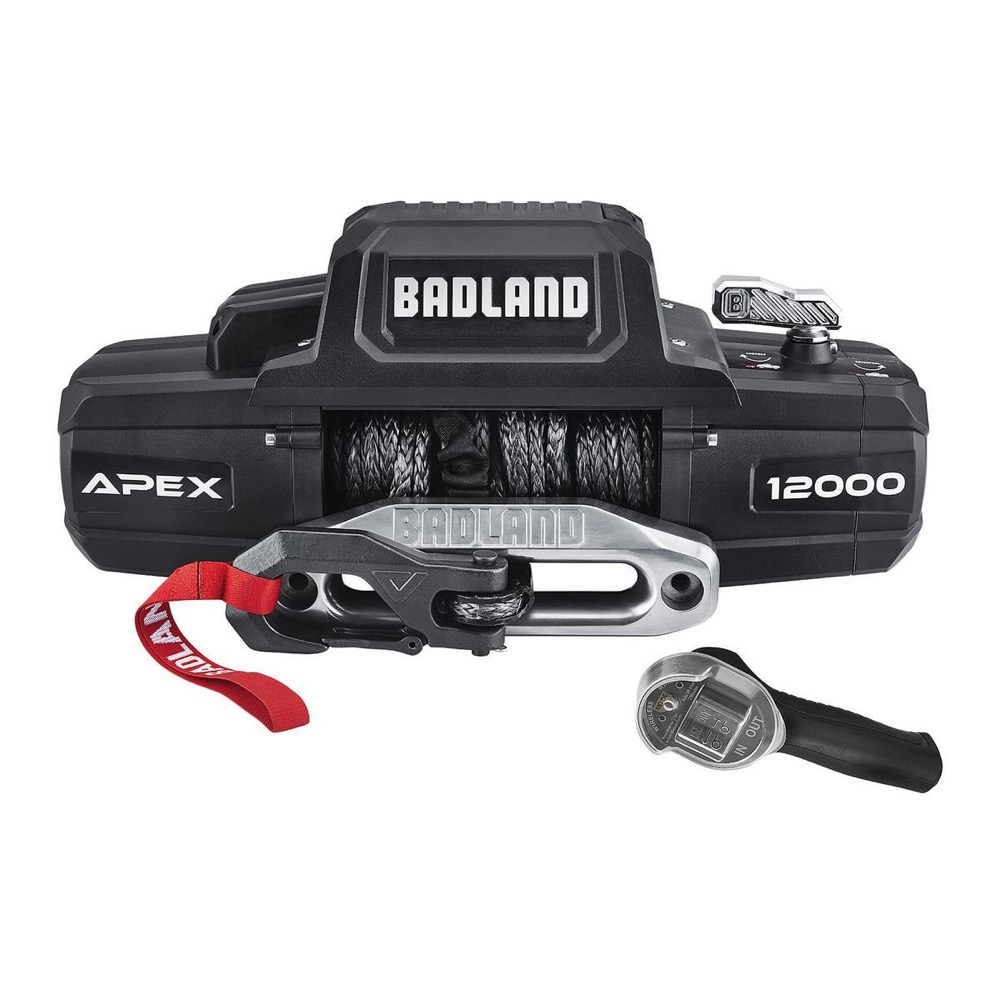
The Badland Apex 12,000 lb winch is Harbor Freight's top Badland winch, and it puts more winch on the front of a truck for the money than anything else we know of. You get a 12,000 lb rated line pull, 80 ft of synthetic rope, a hawse fairlead, a forged hook, a wireless remote with a wired backup, a control box relocation kit and a battery disconnect switch in the box. Owners run them for years, through mud, water and ice, and reported failures are rare. By the sizing rule Harbor Freight and WARN both publish, it meets the minimum for a truck with a GVWR up to 8,000 lb.
What you give up is the safety net. Harbor Freight warrants it for 90 days, and its own duty-cycle rating says a full-load pull runs 45 seconds before a rest of more than 14 minutes. The clutch lever can't be turned to suit a tight bumper, so the install often means relocating the control box or trimming something. And it's sold through Harbor Freight's own stores and website, so our pick links Harbor Freight, and we earn nothing if you buy one.
What it gets right, and the catches
Why we'd buy it:
- A 12,000 lb rating with the numbers behind it: Harbor Freight prints the pull on every layer of rope and the line speed and current draw at each load. WARN doesn't publish a load table on its VR EVO product pages.
- A complete kit: synthetic rope, hawse fairlead, forged hook, wireless and wired remotes, relocation cables and baseplate, and a disconnect switch, so the only big extra is the mount.
- Sealed for water: rated IP68 and IP69K, and owners have run them submerged, frozen and caked in mud for years.
- A store down the road: owners who've had a bad unit describe quick exchanges at their local Harbor Freight. The written warranty terms still call for proof of purchase and an explanation of the fault, so keep the receipt.
What to weigh:
- A 90-day warranty: WARN backs its entry-level VR EVO line with a limited lifetime mechanical and seven-year electrical warranty. Harbor Freight sells an optional extended service plan separately.
- A 5% duty cycle at full load: 45 seconds of pulling at its rating, then at least 14 minutes 15 seconds of rest, per Harbor Freight.
- A fixed clutch lever and a bulky control box: in many bumpers one or the other has to move, or the bumper gets trimmed.
- A free spool that can stiffen: some units get hard to pull out by hand after a few uses.
- Less rope: 80 ft, 10 ft less than WARN puts on its VR EVO winches.
Which trucks and bumpers it fits
A winch fits a mount, not a truck. The Apex needs a winch-ready bumper or a hidden winch mount built for your truck's exact generation, and Harbor Freight's manual says the mounting plate must be rated to at least the winch's capacity. It bolts down through the common 10 x 4.5 in four-bolt pattern. Size it first: Harbor Freight's FAQ and WARN's comparison page both say a winch should be rated for at least 1.5 times your truck's GVWR. Run backward (our arithmetic), 12,000 lb meets that minimum for a GVWR up to 8,000 lb, and the GVWR for your truck is on the label in the driver's door jamb. Our winch sizing guide works through the math for every common size.
The fit problems come from the parts that stick out. The control box sits on top of the winch, and the clutch lever comes out of the gearbox at one fixed angle; Harbor Freight's manual covers moving the control box but gives no way to rotate the clutch, and owners who tried say it can't be done. That makes the Apex harder to fit than its size suggests:
- Bumpers with room above the winch: some go in with the control box still on top. On a 2017 3rd gen Tacoma with a CBI Covert bumper, bending a small tab on the hood latch support was enough.
- Tight steel bumpers: plan to relocate the control box with the included cables and baseplate, or to trim a grille support or bumper brace. Owners mount the box on a crossmember, behind the grille or in the engine bay.
- Bumpers with a low clutch opening: check where the lever lands before you buy. Behind an ARB bumper, one owner cut the lever and notched a crossmember to make it fit, and now finds the free spool hard to turn.
- Hidden mounts behind a factory bumper: measure first. The Apex was too wide for a hidden mount on a 2016 F-150 (Gen13), and on a 2022 F-150 EcoBoost (Gen14) it took an aftermarket intercooler relocation kit, then trimming the bumper posts and part of the bumper, to fit.
Then check what you're hanging off the front. Harbor Freight lists the Apex at 67.2 lb before the bumper, the rope and any lights, and that weight sits over the front axle; compare the bumper maker's figure and the winch's against the front axle rating (GAWR) on the door-jamb label. Ask the bumper or mount maker whether it is rated for a 12,000 lb line pull on your truck and whether its instructions call for frame reinforcement; Harbor Freight's own manual warns that reinforcement plates or welded bracing may be needed depending on the mounting location. Every truck row in our fitment table carries that checklist, because we haven't matched a mount to any truck ourselves.
The specs Harbor Freight publishes
Spec | Badland Apex 12,000 lb (56385) |
|---|---|
Rated line pull | 12,000 lb, single line, first layer |
Rope | 80 ft of 3/8 in synthetic |
Fairlead | Aluminum hawse |
Motor | 12 V series wound |
Gear train | 3-stage planetary; 200:1 on the product page, 201:1 or 210:1 in the manual depending on the revision |
Brake | Automatic cone brake |
Free spool | Rotating ring gear clutch |
Remote | Wireless (50 ft range) plus a 12 ft cable for wired use |
Duty cycle | 5%: 45 sec at max rated load, then 14 min 15 sec rest |
No-load line speed | 31.5 ft/min |
Mounting pattern | 10 x 4.5 in, 4 bolts |
Size | 23-1/4 in long, 6-1/2 in deep, about 10 in high |
Weight | 67.2 lb |
Weather rating | IP68 / IP69K |
Battery and cables | 12 V, 650 CCA minimum; 2 AWG cables minimum |
Warranty | 90 days, original purchaser |
Specs come from Harbor Freight's product page and the Apex owner's manual. The gear ratio is the one number the two disagree on, and the manual's own revisions list two figures, so we print all three rather than pick one. Harbor Freight sells other Badland 12,000 lb winches too, including the ZXR; they're different winches, and nothing owners say about them counts here.
Pulling power by layer, and the duty cycle
The 12,000 lb on the box is a first-layer number, and Harbor Freight is unusually open about what happens after that. Its manual rates each layer of the 80 ft rope:
Rope layer | Rated line pull | Rope on the drum through this layer |
|---|---|---|
1 | 12,000 lb | 16.3 ft |
2 | 9,517 lb | 37 ft |
3 | 7,885 lb | 60 ft |
4 | 6,732 lb | 80 ft |
Here's what that means on the trail (our arithmetic on Harbor Freight's table). With less than about 20 ft of rope out, you're pulling on the fourth layer, where the rating is 6,732 lb, about 56% of the number on the box. The full 12,000 lb is there only with about 64 ft or more off the drum. Take a truck with a 6,000 lb GVWR: the 1.5 rule asks for 9,000 lb, which this winch delivers only from the second layer down, so you'd want at least 43 ft of rope out before a hard pull. That's why Harbor Freight's guide tells you to winch with as much rope out as possible and to use a snatch block when you're close to the anchor or unsure of the load.
Line pull, first layer | Line speed | Current draw at 12 V |
|---|---|---|
No load | 31.5 ft/min | 60 A |
3,000 lb | 12.1 ft/min | 166 A |
6,000 lb | 8.9 ft/min | 259 A |
9,000 lb | 6.7 ft/min | 349 A |
12,000 lb | 4.7 ft/min | 448 A |
Read that table next to the duty cycle. Harbor Freight rates the Apex at 5%: 45 seconds at its maximum rated load, then 14 minutes 15 seconds of rest. At 4.7 ft/min, 45 seconds moves about 3.5 ft of rope (our arithmetic). Harbor Freight's guide is blunt about the rest: a winch with a 5% rating must rest at least 14 minutes 15 seconds after every 45 seconds of continuous operation at its maximum load, and ignoring the duty cycle can contribute to premature winch failure. If the motor stalls, it says to stop and use a snatch block. Lighter loads run faster and draw less current, and Harbor Freight's FAQ says a bigger rating relative to the load leaves more margin before the winch needs to cool. One owner dragging an SUV with locked wheels up trailer ramps had to stop and let the winch cool, which is what the chart predicts. A double-line pull through a snatch block, which Harbor Freight's guide recommends whenever you're in doubt about the load, keeps the winch further from its limit.
Speed splits owners. No-load, the Apex is quicker than WARN's VR EVO line on paper (31.5 ft/min against WARN's 24.8-27.1), and owners coming from older winches like it. Owners used to premium winches call it slow, and a winch that slows to under 5 ft/min at its rating will feel slow to anyone. We'd call the line speed fine for recovery and the duty cycle the number that matters.
Power is the other limit. At 448 A at full load, the Apex leans hard on the truck's electrical system. Harbor Freight specifies a 12 V battery of at least 650 cold cranking amps and cables of at least 2 AWG, recommends a bigger battery for longer or more frequent pulls, and tells you to winch with the engine running. Use the supplied power cables: the manual says not to use thinner or longer cables or link cables together, and for a hitch-mounted winch the FAQ says to run it from a dedicated deep-cycle battery of at least 650 CCA rather than extend the cables to the truck's battery.
Line safety and safe pulls
Unless we say otherwise, every rule in this section comes from Harbor Freight's Badland Guide to Winching, which ships with the winch, and the Apex manual, which tells you to read the guide before you operate it. A winch rope under load stores energy, and when a rope, hook, shackle, strap or anchor fails, that energy goes somewhere. Harbor Freight's rules, like WARN's, are built around keeping people out of the way when it does.
- Never exceed the rating: Harbor Freight's first operating rule is "Do not exceed load capacity. Be aware of dynamic loading!" A sudden load can briefly exceed the rating. The winch's rating never raises anything else's: the rope, hook, shackles, straps, anchor, bumper or mount and the truck's frame each have their own limits, and the lowest one governs the pull. If the motor stalls, stop; don't keep power on it.
- Stand clear: set a danger zone of at least 20 ft on each side of the winch line and beyond the truck and the anchor, and keep everyone out of it while the line is under tension. Stay out of the direct line of the rope, never step over a tensioned rope, and never push sideways against one.
- Use a damper: lay a winch damper or a heavy blanket over the rope on the hook side of the span to help absorb the force if the rope breaks; Harbor Freight's straight-pull steps put it a third of the distance from the hook end. WARN's guide, for its own winches, says midway between winch and anchor. With the Apex, follow Harbor Freight's.
- Gloves and the hook strap: wear safety glasses and heavy-duty leather gloves, never let the rope slide through your hands, keep your hands clear of the fairlead, and use the hook strap rather than your fingers. Don't power the hook into the fairlead.
- Leave rope on the drum: Harbor Freight says to leave at least 5 full wraps on the drum so the rope can't pull loose. That's a floor, not a target. WARN asks for at least 10 wraps of synthetic rope on its own winches.
- Rated anchors and rigging: hook onto a pulling point with a tree strap or chain and a shackle, never by wrapping the winch rope around an object and hooking it back on itself, and close the hook latch. Which points on your truck are rated for recovery is the truck maker's or the bumper maker's call, not Harbor Freight's: use only a point your owner's manual or the bumper maker rates for it, and if neither calls it a recovery point, don't treat it as one.
- No straps, no towing, no lifting: never use a stretchy recovery strap while winching, never drive the truck to help the winch pull, and never use the winch to lift anything vertically or to lift or move people.
- Keep the pull straight: with the Apex's hawse fairlead, Harbor Freight's limit is 15 degrees off center. For an angled pull, use a snatch block and an anchor in front of the winch. Winch with the transmission in neutral; Harbor Freight says winching in gear or in park can damage the transmission, and the parking brake isn't built to hold winch loads.
- The clutch and the remote: never disengage the clutch under load. Unplug the remote and switch off the wireless receiver before you rig, free-spool or work near the rope, drum, fairlead or load. Turn the remote off before you drive, and turn the disconnect switch off whenever you aren't winching; Harbor Freight says off-road vibration can wear through wiring insulation and the switch reduces the risk of a short.
A few habits owners pass around run against those rules, and we'd skip them:
- It pulled more than 12,000 lb, so the rating is conservative: Harbor Freight says not to exceed load capacity, and the layer table says the rating shrinks as rope builds up. Use a snatch block instead.
- Pack the gearbox with grease: the manual says the internal mechanism is permanently lubricated and not to open the housing. Anything the manual doesn't cover goes to a qualified technician.
- Power it out against the brake to loosen a stiff free spool: that's a workaround neither Harbor Freight document describes, so we'd skip it. Harbor Freight's guide says grease can settle in the gear train of a winch that sits, making it hard to free-spool, and to check power in, power out and free spool before every trip; if the clutch still binds, take it back while it's under warranty.
- Cut the clutch lever to clear the bumper: it can leave a lever you can barely turn, and Harbor Freight's warranty excludes alterations. Pick a bumper that clears it, or accept powering the rope out.
- Waterproof means no cleanup: Harbor Freight says to rinse the winch with fresh water after it has been submerged and to inspect it before each use. WARN, for its own winches, says never to submerge them at all.
Living with it
The Apex has a better record than its price would suggest. Owners who name it report years of use without a motor, gear or brake failure, including units run underwater, frozen in ice and pulled through mud, with pickups, Jeeps, a Tundra and its camper, and cars dragged up trailer ramps on the other end of the rope. We'd treat that as a strong track record for a 90-day winch, and as no guarantee: a broken Apex outside the warranty is your cost, not Harbor Freight's.
The common complaint is the free spool. On some units the clutch drags enough that pulling rope out by hand takes real effort, sometimes from new and sometimes after a few pulls; one owner's first Apex was swapped right away because it wouldn't free-spool at all. If yours binds inside the 90 days, return it rather than open it up. The other faults are electrical: a new unit that would power out but not in, and a secondhand report of moisture getting into a winch's electrical box, fixed quickly through Harbor Freight. Keep the receipt, test it in every mode the week you buy it, and test it again before trips.
Plan for the rope as a wear item. Synthetic rope needs watching for abrasion and sunlight, the manual says to replace it if it's frayed or has cut strands, and any replacement must be rated at least as high as the original. One owner replaces theirs every year as routine. The manual also says the rope has to be spooled on under tension before first use, and gives the procedure; skip it and the rope can bind on the drum.
Owners split on Harbor Freight's extended service plan: some swear by it for easy exchanges, others skip it on the strength of the track record and plan to buy another on sale if theirs dies. Both are reasonable bets on a winch at this price. Count what each one costs before you decide, and read the plan's terms, which we haven't reviewed.
Apex or WARN VR EVO?
The cross-shop is WARN's VR EVO line, WARN's entry level. We've reviewed the WARN VR EVO 10-S, and the VR EVO 12-S is its 12,000 lb sibling, which we haven't reviewed. Here's what each maker publishes:
Badland Apex 12,000 | WARN VR EVO 10-S | WARN VR EVO 12-S | |
|---|---|---|---|
Rated line pull | 12,000 lb | 10,000 lb | 12,000 lb |
Meets the GVWR x 1.5 minimum up to (our arithmetic) | 8,000 lb GVWR | About 6,667 lb GVWR | 8,000 lb GVWR |
Rope | 80 ft of 3/8 in synthetic | 90 ft of 3/8 in synthetic | 90 ft of 3/8 in synthetic |
Fairlead | Hawse | Hawse | Hawse |
Gear train | 3-stage planetary, 200-210:1 | 3-stage planetary, 218:1 | 3-stage planetary, 234:1 |
No-load line speed | 31.5 ft/min | 24.8-27.1 ft/min across the VR EVO line | 24.8-27.1 ft/min across the VR EVO line |
Weather rating | IP68 / IP69K | IP68; 240-hour salt spray | IP68; 240-hour salt spray |
Mounting pattern | 10 x 4.5 in, 4 bolts | 10 x 4.5 in, 4 bolts | 10 x 4.5 in, 4 bolts |
Weight | 67.2 lb | Not published | Not published |
Warranty | 90 days | Limited lifetime mechanical, 7 years electrical | Limited lifetime mechanical, 7 years electrical |
Where to buy | Harbor Freight | Amazon | Amazon |
Against the 10-S, the Apex is more winch for less money: 2,000 lb more rating, a wireless remote that ships in the box, and it meets the 1.5 minimum for trucks up to 8,000 lb GVWR rather than about 6,667. Against the 12-S, the rating is the same and the gap is warranty, rope length and what you trust. The WARN costs noticeably more at our check, and for that you get a limited lifetime mechanical warranty and WARN's support for years. WARN's VR EVO has its own wrinkle: a recall of the remotes it shipped with from mid-2019 to late 2022, covered in our 10-S review.
We'd pick the Apex for a truck that winches a few times a year, close to home or with friends, where a dead winch is an inconvenience. We'd pay for the WARN on a truck that travels far from help alone, where a limited lifetime mechanical warranty is worth the difference.
Installing it
Follow the Apex manual for the install. It lists the mounting hardware and the torque values, covers the optional control box relocation step by step, and shows the battery, disconnect switch and remote connections. We don't print torque numbers or wiring steps; if you aren't comfortable with high-current wiring, have a shop do it. The points we'd plan around:
- Underwind only: the manual says to install the winch and fairlead so the rope enters and leaves at the bottom of the drum.
- Relocate before you mount: if the control box has to move, the manual says to do the cable work before the winch goes in the bumper. Plan where the box, the disconnect switch and the wired-remote socket will live, and make sure you can still reach the clutch lever and plug in the remote.
- Drill with care: the manual says to check for fuel lines, brake lines, wiring and structure behind anything you drill, and grommet any hole the cables pass through.
- Spool the rope under tension: before first use, the manual's procedure puts the rope back on the drum under load with a helper watching it wind evenly.
- Test it: run it in, out and in free spool before you count on it, and again before trips.
Expect the bumper to be the hard part. The difference between a quick install and a long one is how much room the bumper leaves for the control box and the clutch lever.
Buy it, or pay for the warranty?
Buy the Apex if your truck's door-jamb GVWR is 8,000 lb or less, you winch a few times a year for yourself, friends or work around the property, and you can live with 90 days of coverage and a store exchange. Pick a bumper that clears the control box and the clutch lever, test the free spool the week you get it, and buy a damper and a tree strap with it. On those terms it's the most winch per dollar we know of.
Pay more for the WARN VR EVO 12-S, or look above it, if you travel alone far from a Harbor Freight, need a long warranty, or run long heavy pulls where a 5% duty cycle will hold you up. And if your GVWR is above 8,000 lb, neither 12,000 lb winch meets the 1.5 rule, whatever the box says.
Our Ratings
Overall score
A 12,000 lb rated pull, and Harbor Freight publishes what it does on every layer and at every load, down to 6,732 lb on the top layer and 4.7 ft/min at full load. By the GVWR x 1.5 rule Harbor Freight and WARN both publish, it meets the minimum for trucks up to 8,000 lb GVWR, and owners report pulling out pickups, Jeeps and a Tundra with a camper. It loses points for a 5% duty cycle at full load and 80 ft of rope.
Owners report years of use without a motor, gear or brake failure, including units run underwater and frozen, and it's rated IP68 and IP69K. Against that, and it counts for a lot: Harbor Freight backs it for 90 days, where WARN backs its VR EVO with a limited lifetime mechanical and seven-year electrical warranty, so a failure after three months is yours to deal with. Add a free spool that stiffens on some units, the odd new unit with a control fault, and a sealed gearbox Harbor Freight says not to open.
Synthetic rope, a hawse fairlead, a forged hook, wireless and wired remotes, a relocation kit and a disconnect switch come in the box, and it was noticeably cheaper than WARN's 10,000 lb VR EVO 10-S at our check, with frequent store sales on top. Against that: 90 days of coverage, an extended plan that costs extra, a mount you buy separately, and one place to buy it. Check the current price at Harbor Freight.
The evidence behind our verdict
Owners rate the Badland Apex 12,000 lb winch highly for the money. Most run it on Jeeps, 4Runners, Lexus GXs, Land Cruisers and car trailers; the pickups include Tacomas, Tundras, a Gen14 F-150 and Colorado ZR2s. Owners report two to five years of use without a failure, some after running it submerged or through deep mud.
The friction is fitment and the free spool: many installs needed the control box relocated or a bumper brace trimmed because the clutch lever can't be rotated, and a few owners describe a free spool that was stiff from new or stiffened after a few pulls. Owners split on whether the line speed is too slow and on buying Harbor Freight's extended plan. We'd buy it for a truck with a GVWR up to 8,000 lb, on a bumper that clears it, knowing the warranty is 90 days.
In owners' own words, each linked to the original post.
What Reddit owners say
“I've had a Badlands Apex winch for about 4 years. Ive beat the hell out of it and it works great. I've had it completely submerged, frozen in ice, caked with mud hundreds of times, and used to push over small trees. It works perfectly. The only maintenance i do to it is replace the synthetic line every year.”View thread →
“I've had mine for 2 years, trouble free. The one thing you can expect is dirty looks from Warn fan boys. But I like the line speed and the remote on my Apex. It just works.”View thread →
“I had the 12k badlands apex in a previous rig, I really liked it. I did not buy the extended warranty, and I never had any problems with it in my ~3 years of ownership and use.”View thread →
“My next issue was my badland apex 12k winch from harbor freight was too wide to put in between the bumper posts by about half an inch. I ended up having to trim the posts AND a portion of the interior of the bumper so everything would mount flush.”View thread →
“Apex 12k on my car hauler trailer, no issues. It does overheat and have to be paused just like all non hydraulic winches I’ve owned, but it takes a bit to get there (dragged a awd suv with the wheels locked up 50 ft on the ground and up my ramps before it needed to chill for a few)”View thread →
“My non-Apex Badlands 12k free spools much easier and I definitely had the same question as you when I got the Apex. I actually had to get my first Apex replaced immediately because it wouldn’t free spool at all.”View thread →
“I’ve never seen one fail in the field. BUT! Every Badlands Apex 12k I’ve pulled line out of is a HUGE PIA!! Not an issue when they are brand new but after a few pulls they all seem to get really hard to pull line in free spool. Have 2 of them and both mine take 2 guys to pull the line out now.”View thread →
“Badlands are so slow, and short of rope, not a fan. I have three warns, a smitty built and a badlands apex. I'll take the smitty all day over the harbor freight, and warn for the win.”View thread →
What the owner forums say
“My Warn VR died a few years ago. I bought a Harbor freight Apex 12k with synthetic line. While I warrantied the Warn. That was 3 years ago. Apex is still on my truck and been great. I’ve used it for a couple dozen pulls.”Source →
“I have the HF apex 12k. I love it. It hasn't given me any trouble, and the wireless remote it great. I've used my winch alot, mostly for projects, not many recoveries. But it did pull out my tundra and 8k camper that was sunk in the mud in my buddies field.”Source →
“2017 3rd Gen Tacoma CBI Covert bumper on APEX Badlands 12k Winch ... I was able to leave the control box attached to the winch because I bent a small tab on the bottom of hood latch support bracket.”Source →
“I fit a new 12K Apex in an SSO slimline bumper. I had to relocate the control box, which i suspect you will need to also. The Apex comes with relocation studs/hardware.”Source →
“FWIW, I made the 12k Apex fit behind my ARB. Yes, it would have been a lot cleaner if it was clockable. I ended up cutting the selector and notching the AC condenser crossmember. I can* free spool but it’s a pita to turn the selector so I usually just winch out when I need it.”Source →
Frequently asked questions
Is the Badland Apex 12000 worth it?
Synthetic rope, a hawse fairlead, a forged hook, wireless and wired remotes, a relocation kit and a disconnect switch come in the box, and it was noticeably cheaper than WARN's 10,000 lb VR EVO 10-S at our check, with frequent store sales on top. Against that: 90 days of coverage, an extended plan that costs extra, a mount you buy separately, and one place to buy it. Check the current price at Harbor Freight.
How durable is the Badland Apex 12000?
Owners report years of use without a motor, gear or brake failure, including units run underwater and frozen, and it's rated IP68 and IP69K. Against that, and it counts for a lot: Harbor Freight backs it for 90 days, where WARN backs its VR EVO with a limited lifetime mechanical and seven-year electrical warranty, so a failure after three months is yours to deal with. Add a free spool that stiffens on some units, the odd new unit with a control fault, and a sealed gearbox Harbor Freight says not to open.
How does the Badland Apex 12000 rate on pulling performance?
A 12,000 lb rated pull, and Harbor Freight publishes what it does on every layer and at every load, down to 6,732 lb on the top layer and 4.7 ft/min at full load. By the GVWR x 1.5 rule Harbor Freight and WARN both publish, it meets the minimum for trucks up to 8,000 lb GVWR, and owners report pulling out pickups, Jeeps and a Tundra with a camper. It loses points for a 5% duty cycle at full load and 80 ft of rope.
What do real owners say about the Badland Apex 12000?
Owners rate the Badland Apex 12,000 lb winch highly for the money. Most run it on Jeeps, 4Runners, Lexus GXs, Land Cruisers and car trailers; the pickups include Tacomas, Tundras, a Gen14 F-150 and Colorado ZR2s. Owners report two to five years of use without a failure, some after running it submerged or through deep mud.
Other options worth a look

WARN VR EVO 10-S Winch (Synthetic Rope)
Our pick for a midsize pickup or light half-ton with a GVWR under about 6,667 lb: 10,000 lb rated pull, 90 ft of synthetic rope and WARN's limited lifetime mechanical warranty. The steel-cable VR EVO 10 and the mount are sold separately.
Read our full review. We scored it 7.0/10.
You Might Also Need
Accessories worth grabbing alongside your purchase


